This article focuses on practical trends for experienced buyers who already understand fundamentals and want to squeeze more profit from mature GEOs, complex caps, and multioffer setups. The main topics: where automation delivers maximum leverage, when AI creatives genuinely improve performance, and how to avoid losing control over campaigns while delegating tasks to algorithms.
From Manual Hustle to Systematic Casino Affiliate Operations
In the early stages, many casino affiliate teams grow mostly through brute-force effort. A small crew launches dozens of test campaigns, lives inside the dashboards almost around the clock, and tweaks bids or blacklists manually. That model stops working once spend climbs to serious numbers. Human attention no longer covers every combination of a correctly chosen GEO, placement, creative, and device.
Modern stacks move toward structured operations. Automated rules pause placements with too many spend and too few registrations. Scripts rebalance budgets between campaigns based on real-time performance. Dashboards highlight anomalies so buyers can react fast.
Within that context, the phrase casino affiliate 2026 describes not only a time period but also a new standard of maturity. Teams that ignore automation compete against rivals who react faster, sleep more, and still keep better control of risk.
Where Automation Brings the Highest ROI
Automation pays off most in repetitive, rule-based actions where emotions often push buyers toward poor decisions. Instead of guessing when to stop a test or scale a winner, teams encode clear logic.
Typical high-impact use cases:
Automatic pausing of creatives or placements once spend exceeds a threshold without registrations or deposits.
Budget reallocation from low-ROI campaigns toward stronger ones based on rolling performance windows.
Dayparting rules that reduce spend during consistently weak hours and restore it during prime time.
Frequency capping and rotation logic that prevent overexposure of a single creative to the same segment.
Alert systems that ping a channel when KPIs deviate from normal ranges.
A clear strategy defines where humans still make final calls. For example, a rule can pause underperforming ad sets, while a senior buyer reviews paused segments once per day and decides whether to kill or revive them with new angles.
How Automation Changes Daily Workflows
Once automation enters the picture, the role of a casino affiliate shifts from button-pushing toward high-level design and diagnosis. Instead of moving bids up and down all afternoon, buyers spend more time:
Designing testing frameworks and defining thresholds for rules.
Analyzing multi-day data patterns rather than hour-to-hour noise.
Coordinating with product and CRM teams on promo calendars and player value.
Building training materials so junior staff understands why rules operate as they do.
In other words, modern casino affiliate work in 2026 describes a world where the best-paid person in the team optimizes systems, not individual campaigns. That mindset frees attention for strategic moves such as entering new GEOs or negotiating better rev-share deals.
AI Creatives: Hype, Reality, and Best Use Cases
AI image and video generators exploded over the last couple of years. For casino offers, they open new possibilities: rapid production of visual themes, localization at scale, and unique stylization without expensive designers on every step.
However, not every AI-generated asset converts. Algorithms easily produce flashy yet generic visuals that fail to communicate value or trigger action. A strong pipeline treats AI as a creative assistant, not a magic button.
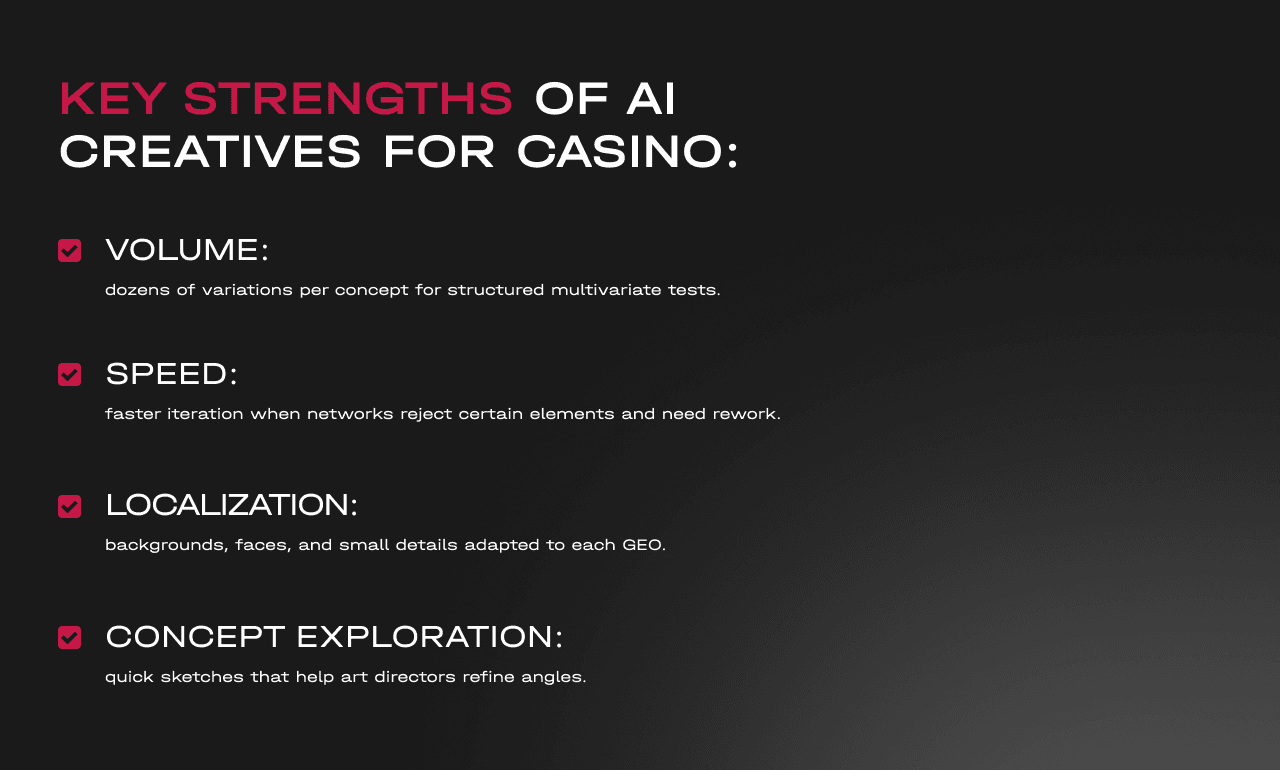
Key strengths of AI creatives for casino:
Volume: dozens of variations per concept for structured multivariate tests.
Speed: faster iteration when networks reject certain elements and need rework.
Localization: backgrounds, faces, and small details adapted to each GEO.
Concept exploration: quick sketches that help art directors refine angles.
On the other hand, weak prompts or lack of clear strategy lead to spammy banners that burn audiences. AI improves productivity only when the team already understands behavioral triggers, compliance rules, and offer positioning.
Do AI Creatives Actually Improve Performance?
Many advanced buyers ask not just how to build more creatives, but how does casino affiliate marketing work in 2026 when AI enters every stage of production. The short answer: AI raises the ceiling for testing but does not replace insight.
Performance impact usually appears in three areas:
Faster discovery of winning angles. Instead of five banners per week, teams test dozens and see faster what ideas specific segments capture.
Longer life cycles for campaigns. When a concept fires, AI helps generate fresh variations that preserve the main message and remove the "banner blindness".
Better alignment with micro-segments. Different age groups, devices, and GEO respond to different visual details. AI allows you to customize a creative segment without huge design costs.
In many cases, CTR increases first, then conversion increases with the correction of messages. The profit does not come from the tool itself, but from how systematically the team knows how to use it.
Balancing Automation With Human Judgment
Overreliance on automation brings real risks. Rules built around short time windows can kill promising tests during temporary dips. Scripts that chase short-term ROI sometimes starve campaigns that bring high-value players with longer payback periods.
Healthy stacks follow a few principles:
Important rules remain transparent and documented for the whole team.
Every automated action leaves a log so analysts can audit decisions.
Critical thresholds base on cohort data and real player value, not only on front-end metrics.
Senior buyers retain authority to override rules when strategic reasons exist.
Automation should work like an exoskeleton for your team, not a cage around it. When it’s designed properly, it shields your funnel from emotional decisions and slow reactions, while still leaving room for strategic risks and bold creative experiments.
Practical Examples of Automation in Casino Funnels
Consider a team that runs several GEOs on multiple traffic sources. Instead of manually scanning placements, they configure a rule engine:
If a placement spends more than X with zero registrations, have it pause automatically.
If a campaign hits your target ROI for three days in a row, automatically nudge the budget up by a fixed percentage.
If conversion rate drops below a threshold across the account, send a real-time alert so someone checks tracking, landing pages, or payment methods.
Parallel to that, scripts connect BI dashboards with partner backends. Data flows daily, giving an accurate view of deposit value per campaign and source. Automation handles repetitive synchronization so analysts focus on identifying opportunities, not cleaning CSV files.
In such a system, a casino affiliate 2026 professional spends time on designing conditions, not chasing red numbers on a screen.
Where Automation Does Not Fit Yet
Not every process deserves automation. Areas that still benefit from human handling include:
Deep creative strategy and narrative development for long-term brands.
Negotiation with account managers, networks, and content partners.
Sensitive compliance decisions when regulations shift rapidly.
Experimental funnels where data remains too thin for reliable rules.
Early phases of a new GEO or traffic source often require manual control. Once stable performance patterns appear, rules and scripts take over routine actions.
Using AI Beyond Visual Creatives
AI adds value not only in banners and videos. Text generators already help with:
Headline ideas for different awareness levels and angles.
Pre-lander drafts adapted to various personas and stages of the funnel.
Email and push content for reactivation and cross-sell journeys.
Data summaries that highlight anomalies in large performance reports.
Experienced teams avoid copy-paste. AI output goes through human editing for clarity, compliance, and brand tone. Over time, prompt libraries grow into an asset of their own, as reliable recipes for specific GEOs and verticals.
Future Trends Shaping Casino Affiliate 2026 and Beyond
Looking a bit further, several trends stand out for casino affiliates:
More privacy restrictions and tracking gaps, pushing teams toward first-party data and server-side setups.
Growing importance of CRM and retention since new deposits cost more each year.
Wider use of predictive models to estimate player value early in the lifecycle.
Closer collaboration between traffic teams and product owners to tailor promotions.
In this landscape, casino affiliate operations in 2026 rely on multi-disciplinary skill sets. A strong buyer understands media, data, user psychology, and at least basic scripting. Teams that consistently invest in training and documentation adapt much faster than those that just chase the latest hack.
How Casino Affiliates Can Stay Ahead in 2026
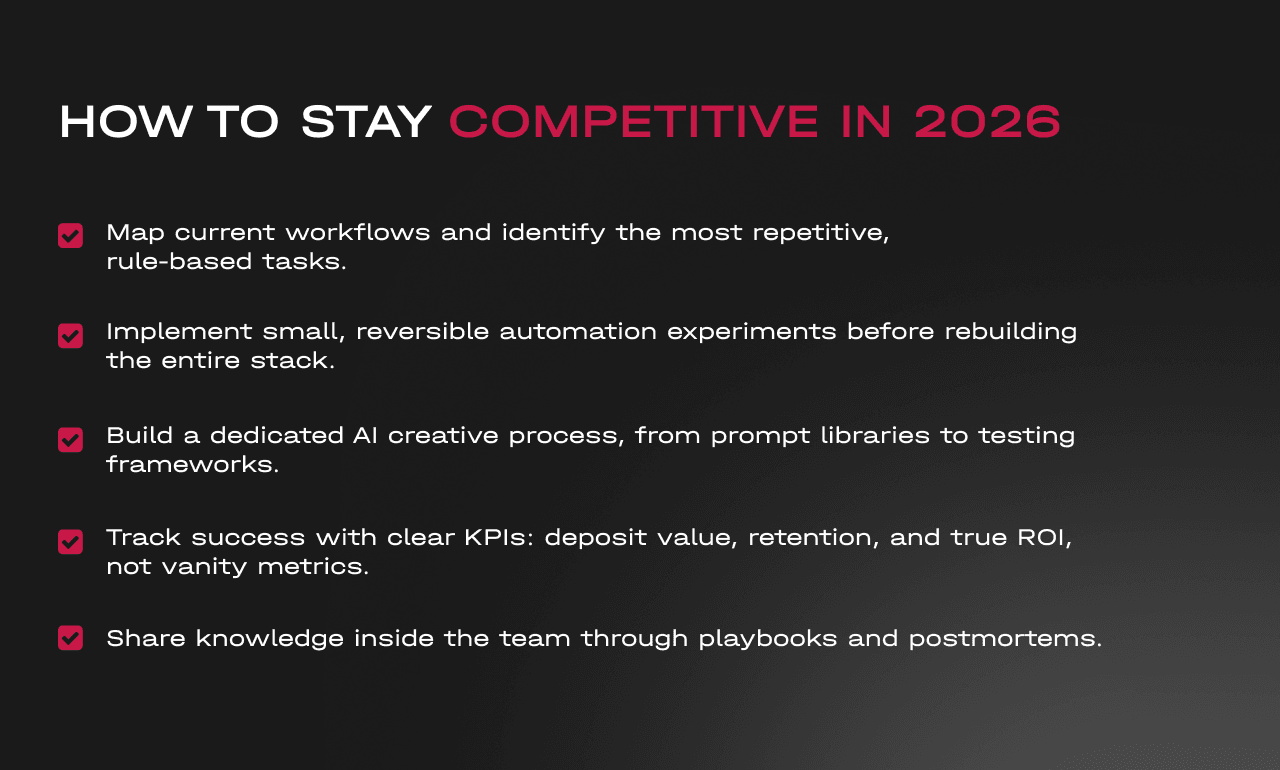
To stay relevant in a landscape shaped by automation and AI, casino affiliates can follow a few practical steps:
Map your current workflows and highlight the most repetitive, rule-based tasks.
Start with small, reversible automation experiments instead of rebuilding the entire stack at once.
Build a dedicated AI creative pipeline, from prompt libraries to structured testing frameworks.
Measure success with clear KPIs: deposit value, retention, and true ROI, not vanity metrics.
Share knowledge inside the team through playbooks, internal docs, and regular postmortems.
The core question no longer focuses on whether automation or AI have value. The stronger question: how does casino affiliate marketing work in 2026 for teams that treat tools as part of a coherent operating system instead of shiny toys?
Conclusion
Casino affiliate work in 2026 evolves beyond manual optimization and random tests. Automation takes care of routine actions with machine-level discipline, while AI expands both your creative and analytical capacity. Together, they free experienced buyers to focus on strategy, positioning, and long-term relationships with players and partners.
Teams that learn to design resilient systems instead of chasing short-term tricks gain a lasting edge. Structured automation, thoughtful use of AI for creatives, and a strong analytical culture can turn volatile casino funnels into reliable engines of growth. Those who adapt to this new environment define the next generation of leaders in the casino affiliate 2026 landscape.