In this article we will break down how payouts work, where the risks hide, how to calculate unit economics, and how to choose the right model for your traffic source, geo, and time horizon. I will use the everyday terms cpa and revshare along the way, because that is how affiliates talk in real life.
Let’s agree on the terms first
Both models sound simple. The tricky part is always the conditions.
CPA is a fixed payout for a qualified action, most often an FTD (first deposit). Some programs add extra requirements: KYC completion, minimum deposit amount, minimum wagering, no bonus abuse, and so on. In practice, your real payout depends less on the headline number and more on how many leads actually pass qualification and do not get rejected.
In iGaming language, you will often see this described as Cost Per Acquisition iGaming when the action is a real-money depositing player and not just a registration.
RevShare is a percentage of the casino’s net revenue generated by your referred player. Most brands calculate it from NGR, not from turnover. That means deductions can include bonuses, payment fees, fraud adjustments, and sometimes other items depending on the program.
This is why CPA vs Revenue Share casino cannot be judged by percentage alone. Two programs can offer the same percent and deliver very different monthly results once deductions kick in.
In short: CPA gives fast cashflow, RevShare builds long-term earnings. In 2026, the better model is decided by conditions, traffic quality, and how you manage risk. In real casino affiliate revenue models, almost nothing is pure because there are always extra quality and retention rules.
What changed in 2026

Trend 1: stricter quality control. Many programs tightened validation. For CPA, this often means harsher FTD qualification and stricter source/geo limits. For RevShare, the hottest topics are NGR formulas, negative carryover, and quiet restrictions on certain player segments.
Trend 2: teams think beyond today’s approval rate. Rising traffic costs and platform instability pushed more affiliates to think in LTV terms. That is why you see more hybrid deals and longer agreements where you get a fixed part plus a percentage. This shift is one reason the CPA RevShare comparison 2026 looks different than it did a few years ago.
Trend 3: model depends on the traffic source. One model for everything performs worse in 2026. SEO, PPC, influencers, and push traffic can produce opposite results under the same deal. In other words, modern gambling affiliate payment models are not about preference, they are about fit.
CPA: what you are actually paid for
CPA is popular because it gives fast feedback. You launch, measure conversion, get paid, reinvest. For newer teams, it is psychologically easier: clear numbers and a short cycle.
But there are three layers affiliates often underestimate…
1) Qualification and rejections
A deal might advertise $150, but if half the FTDs fail the conditions, your effective rate collapses. That is why CPA vs RevShare casinos always start with one question: what counts as a valid player here? Sometimes it is FTD + KYC, sometimes only FTD, sometimes there is also wagering required.
2) Geo and source filtering
A program can pay great for Tier-1 but cut the same style of traffic in Tier-3. In 2026, many brands spell out source restrictions and require channel disclosure. This matters a lot if you scale paid acquisition.
3) Payment delays and holds
Large CPA payouts usually come with holds. That is normal, but you must plan for cash gaps. If you are buying traffic, you can land in a situation where costs are paid today while payouts arrive 30 days later.
CPA works best when you need speed and your approval rate is stable. What CPA does not like is gray uncertainty. A small rule update can wipe weekly profit.
To keep CPA honest, always run a simple CPA RevShare payout comparison on the same traffic batch: what do you earn per 100 clicks under CPA after real approvals, not promised approvals.
RevShare: where the money is, and where the traps are
RevShare sounds like a dream: bring a player once and earn for months. In practice, RevShare behaves like an investment. You feed traffic in, and returns are spread over time and shaped by player behavior and operator policy.
To judge RevShare fairly, you need to understand four things…
1) What NGR means in this exact program
NGR can differ. Some brands deduct bonuses and payment fees. Others add fraud corrections. Some include chargebacks. This is the core reason you cannot rate CPA vs Revenue Share casino by feel. You must know the deductions.
2) Negative carryover
If a player wins big in one month, your account can go negative and carry into the next month. You earn nothing until the player’s net results swing back. This is the biggest practical trap of RevShare.
3) Retention and promo policy
RevShare depends on how the casino retains players. If the product is weak, even good traffic burns out fast. That is why the debate is not only about terms, but about the operator itself and its real retention engine.
4) Control and privacy risk
With RevShare, you control less. Casinos can change bonuses, payment options, and limits. You do not control those levers, but they change your monthly revenue.
RevShare often wins on longer horizons, especially if you have stable repeat users and strong content. That is why many teams treat RevShare as the backbone of casino affiliate revenue models rather than a quick win tactic.
Table: when each model makes more sense
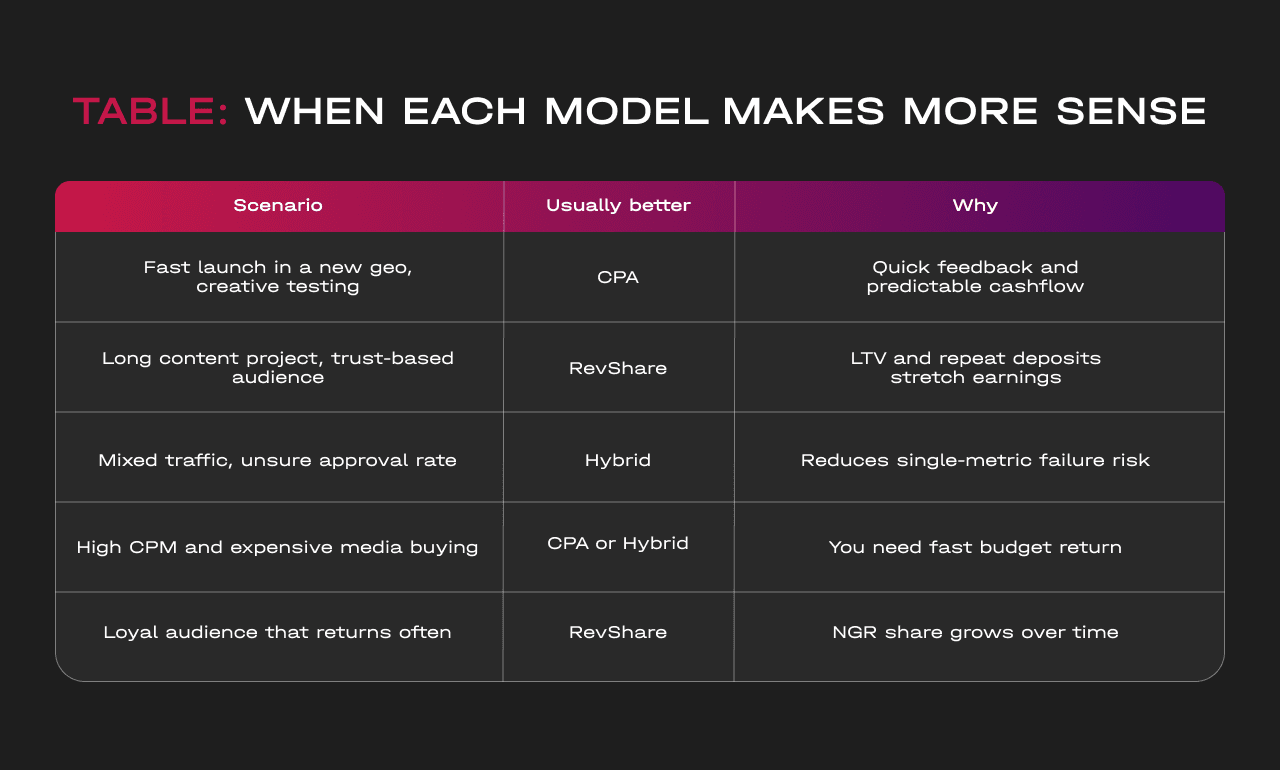
This is the essence of the comparison: you choose not the best among all, but the best for your specific situation.
CPA or RevShare: calculate, do not argue
If you need a fast decision, use the same traffic volume and run two models on paper.
Estimate expected FTD volume and approval under CPA.
Estimate average NGR per player and retention at 30, 60, 90 days.
Compare not only profit, but also cash gaps.
And yes, CPA or RevShare gambling almost always depends on the horizon. If you plan to run a funnel for two weeks, CPA usually looks stronger. If you are building an asset for months, RevShare often catches up and overtakes.
A useful metric here is CPA RevShare ROI. CPA ROI is immediate and easier to track weekly. RevShare ROI is slower, but can be more stable once the player base compounds.
Questions you should ask the affiliate manager
Do not guess. Ask and document answers.
Exact CPA qualification: only FTD or FTD + KYC, minimum deposit, minimum wagering
Allowed sources and geo restrictions
RevShare: what is included in NGR and is there negative carryover
Hold period and payout schedule
How disputes are handled for fraud and bonus abuse
These answers define your real commission, because commission is not only the rate but also the rules that can quietly eat your margin. For anyone doing CPA vs RevShare iGaming, this checklist prevents the most common surprises.
Choosing by traffic type
Now the practical part. The same program can be great for one source and weak for another. This is why casino affiliate CPA vs RevShare decisions should be made per channel, not once for the entire business.
SEO and content
If you run sites, reviews, and organic traffic, you typically play long-term. People trust your recommendations, come back, and deposit again. That is why SEO traffic often leans toward RevShare or hybrid. Stability matters more than one-time approvals.
Media buying and paid traffic
When you buy traffic, you live in a spend today, get returns tomorrow loop. CPA often makes sense because it reduces the risk of waiting months for revenue. But if approvals drop, CPA becomes toxic fast.
Influencers and community
With Telegram, streams, or a personal brand, your audience can be loyal and recurring. That is where RevShare can perform strongly, but only if the NGR formula is fair and negative carryover is not abusive.
Mixed sources
If your traffic is mixed, start with a hybrid deal. In 2026, many programs use hybrid as a compromise: slightly lower fixed payout, but you test quality while building a long tail. This is one reason CPA vs RevShare iGaming is often a process, not a one-time choice.
Typical beginner mistakes
The most common mistake is choosing a model by the headline number instead of conditions. The second mistake is thinking RevShare is passive while CPA is active. In reality, both require control and analytics:
Lock down the NGR formula and negative carryover rules before launch
Track performance by geo, source, and creatives separately
Do not keep all income in one program even if it looks perfect today
Those habits matter across all gambling affiliate payment models, because risk usually shows up after scaling, not before.
How to choose in 2026
Here is a simple approach that does not overload you.

That turns CPA vs RevShare casinos from an argument into a calculation. And in real operations, you will revisit the decision often as traffic changes and platforms shift. This is the healthy way to treat CPA RevShare comparison 2026 in practice.
Also note that many teams use Cost Per Acquisition iGaming early to stabilize cashflow, then migrate part of the portfolio into RevShare once they have predictable retention and better forecasting.
Final takeaway
There is no universal winner in 2026. CPA gives speed and predictability, but depends heavily on approvals and rules. RevShare creates a long tail, but requires a transparent NGR formula and reasonable carryover policies, otherwise profit can leak quietly.
If you are building a system, not a one-off funnel, remember one simple idea: the best strategy is the one that matches your traffic source, your horizon, and your risk tolerance. That is what makes CPA vs RevShare iGaming a business decision, not a preference.
Want a deal that fits your traffic in 2026? Message your affiliate manager, confirm your geos and sources, and ask for the best option for your case: CPA, RevShare, or hybrid.