Articles
Types of advertising on the internet: which formats do affiliates use
What types of advertising exist on the internet? What type of advertising is most effective in affiliate marketing.

The fastest way to stall is to chase every new channel at once. Casino and betting acquisition punishes messy setups: you can get clicks easily, but you cannot force retention, repeat deposits, or stable approvals.
This is a continuation-style guide for affiliates who buy, build, and optimize campaigns daily. It focuses on channel behavior, testing logic, and what to watch when you pair traffic with offers. If you treat your affiliate marketing traffic sources like a system, you stop restarting every month and start building something that holds.

The market did not suddenly invent new traffic. What changed is how quickly weak signals show up. If a source brings the wrong intent, you see it in early churn, quality flags, and shaky payout confidence. If a source is unstable, you see it in approvals, review cycles, and forced asset changes.
This is why you should not pick channels based on what sounds popular. You should pick based on what you can operate without constant firefighting. In casino and betting, the best strategy is usually boring: fewer channels, clearer roles, and stricter stop rules. That is why the best traffic sources for affiliate marketing in 2026 are the ones you can run calmly, measure cleanly, and scale without rebuilding the whole setup.
Before you scale anything, lock the basics. This one step saves you more money than another creative iteration.
Here is what you should confirm for every source you plan to run:
Whether the offer explicitly allows the channel, plus any quiet restrictions by GEO
What the user must do after the click, and where friction might kill conversion
What you will measure beyond the first deposit, including repeat behavior
What happens when a campaign hits a compliance review or a delivery slowdown
Which parts of the flow must stay consistent so you can compare tests fairly
If you do this consistently, you build a clean baseline. That baseline is what turns traffic sources affiliate marketing planning into a process instead of guesswork, especially when you manage multiple offers.
If you only rely on paid, your business becomes a reaction loop. That is why the best free traffic sources for affiliate marketing are still the ones you control: assets that keep working even when ad accounts slow down.
SEO still works in 2026, but only when it is built for action. You do not need more pages. You need the right pages. That is the point of high-value SEO: it filters intent before you pay for retargeting.
The pages that usually earn real deposits in casino and betting look like this:
Deposits and withdrawals by payment method, written as steps the user can follow
GEO-fit comparisons that explain who an offer matches and who should skip it
Bonus pages that focus on conditions first, not excitement
Practical guides that remove uncertainty about what happens after signup
When you build these assets, you get traffic that arrives with questions that matter. This is why high-value SEO remains a core layer for affiliates who care about long-term margin, not just short spikes.
Owned traffic is not only websites. Communities and email lists work because they multiply touchpoints without multiplying costs. They also give you a controlled environment where you can explain flows clearly, which reduces refunds and support drama.
A clean owned setup typically has three pieces: a hub page, a segmented list, and a community layer that keeps users warm. When these are structured, they become reliable affiliate traffic sources that support every paid test instead of competing with it.
Paid is still essential. The mistake is treating every paid channel as a scaling channel. In practice, you need one main lane you can scale and one lane you use for fast learning. That structure is how strong teams keep budgets under control.
Search works because intent is visible. People tell you what they want, and you meet them with a page that matches the query. That makes search one of the few paid traffic sources for affiliate marketing that can stay predictable when the messaging is disciplined.
To keep search tests clean, stick to a few rules:
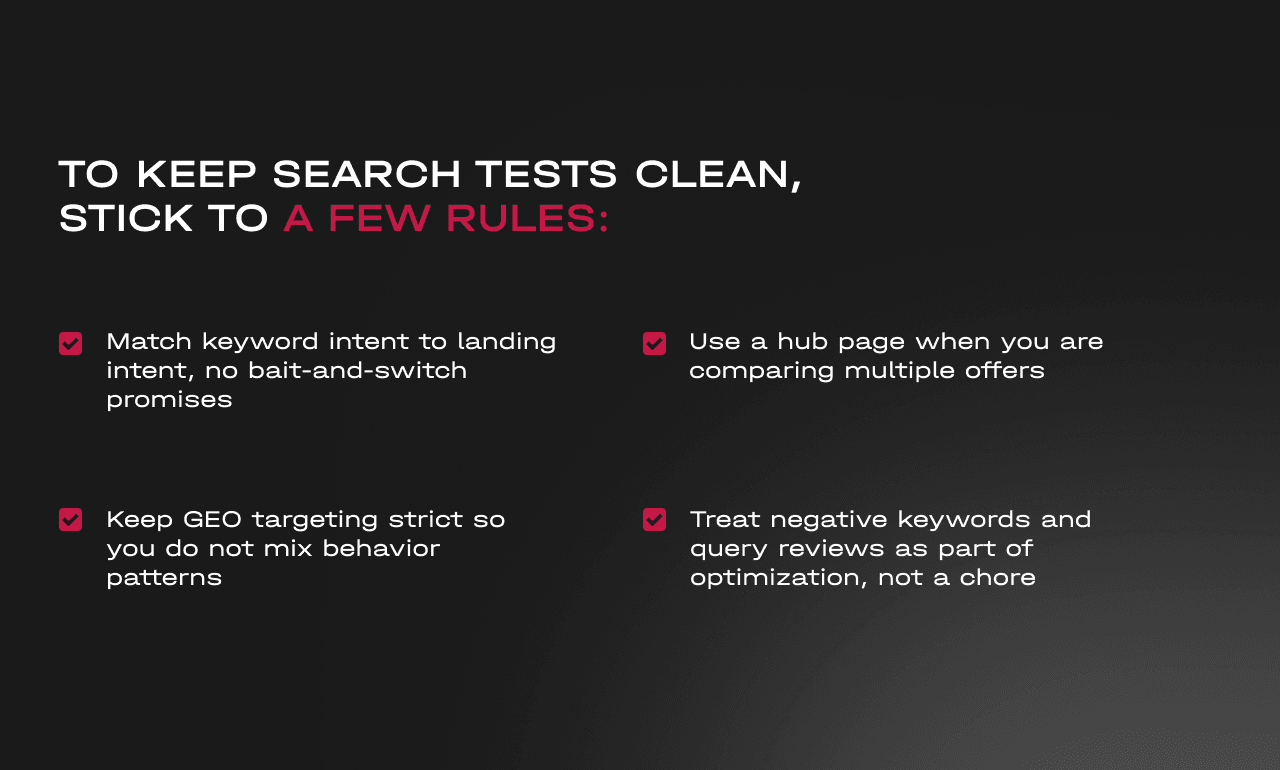
Match keyword intent to landing intent, no bait-and-switch promises
Keep GEO targeting strict so you do not mix behavior patterns
Use a hub page when you are comparing multiple offers
Treat negative keywords and query reviews as part of optimization, not a chore
Search is not just a scale channel. It is also a research channel. The queries that convert often become your best next SEO assets.
Native works when you frame the click properly. Creators work when the audience match is real. Both channels can lift quality, but only if you do not overload the user with mixed promises.
A clean setup usually relies on:
One angle per campaign, not five angles at once
One destination hub that routes users to the right offer for their GEO
A landing experience that explains what the user will see after signup
Tracking that separates tests by intent, not just by placement name
For many teams, this combination ends up being among the best paid traffic sources for affiliate marketing because it balances scale with context. You can warm the user before the offer click, which often improves retention.
Push is best used as a fast feedback tool. It exposes weakness quickly: weak landers, unclear positioning, mismatched GEOs. That is good, as long as you treat it as learning, not as a permanent foundation.
Use push to validate angles and GEO response, then move winning concepts into stronger lanes. When you run it that way, it helps you protect your main budget and avoid scaling noise.
Traffic does not fail in isolation. It fails when it is misaligned with offer rules. Many payout disputes happen because affiliates scale first and read restrictions later.
Before you commit budget, confirm these partner-side points:
Allowed sources by GEO, plus anything that requires pre-approval
Attribution rules, including what counts as invalid activity
Bonus and VIP policy details that can change player behavior
Reporting clarity so you can reconcile numbers without guesswork
Escalation speed if you need an answer fast during scaling
When this is locked, you can scale with confidence. You also waste less time arguing about quality, and more time improving performance. This is where traffic sources for affiliate marketing stop being a risk and start being a controllable system.
You do not need ten channels. You need a stack where every lane has one job. When each lane has a clear job, it becomes easier to spot your best affiliate traffic sources and cut everything that only adds noise. That is how you build results that hold through policy changes and offer rotation.
A practical 2026 structure looks like this:

Owned lane for stability: SEO assets plus a segmented list
Scale lane for volume: search or native, depending on what you can operate cleanly
Learning lane for speed: push tests or limited creator placements with tight tracking
This is the easiest way to compare performance across GEOs without mixing signals. It also helps you decide what to keep and what to drop. Over time, this is how most teams assemble the best affiliate traffic sources for their exact setup, not someone else’s.
Most problems repeat across teams. If you learn to recognize them early, you can fix them before they become expensive.
The most common failure patterns are:
You scale before the first clean cohort shows repeat behavior
You mix GEOs and lose clarity on what actually worked
You change creatives and landers every day, so results are not comparable
You judge channels by cheap clicks instead of value after deposit
You run one channel for everything and blame it when it breaks
The fix is not complicated. Separate roles, tighten measurement, and stop scaling until your funnel is stable. That discipline is what turns affiliate traffic sources into an advantage instead of a constant reset loop.
In 2026, you are not competing on access to traffic. You are competing on how cleanly you operate it. The best traffic sources for affiliate marketing are the ones you can measure, repeat, and scale without surprises, even when rules tighten. Over time, this discipline is what shapes the best affiliate marketing traffic sources for your GEO mix, because performance stays tied to intent and clean operations.
Keep your stack small, keep roles clear, and keep partner rules aligned with your channel plan. Do that, and you will naturally end up with the best affiliate marketing traffic sources for your GEO mix and your offer set. That is the difference between busy testing and real growth.
You may also like