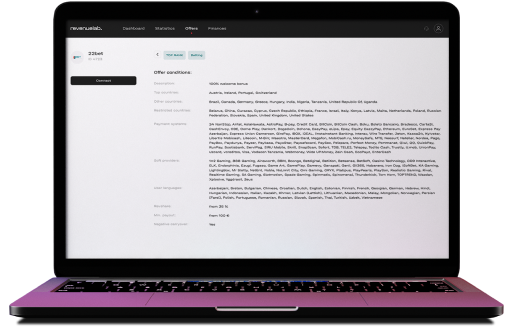
How gambling affiliate arbitrage works in brief
An affiliate takes an offer from a casino or a sportsbook and drives traffic to it. Payouts for target actions follow several basic models.
CPA — a fixed fee for the first deposit (FTD).
RevShare — a percentage of the operator’s net revenue.
Hybrid — a mix of CPA and RevShare.
For stable operations, set clear KPIs: signup cost, FTD cost, funnel depth, retention. Without tracking and analytics, reaching profitability turns into a lottery.
The main beginner question — what budget is needed
The question of budget comes up for every beginner as soon as an offer and a traffic source are on the table. The amount depends on GEO, click prices, the offer’s payout model, and the level of competition across ad networks. Entry thresholds, moderation requirements, and expected hold periods also matter, as they influence payback speed and the feasible size of the first test.
To stay focused, organize spending into a few buckets. The core set covers traffic purchase, tracking and analytics tools, production of creatives and pre-landers, infrastructure (domains, VPS, SSL), a testing fund, and a buffer for cash gaps. A clear structure helps define daily testing limits, the size of a safe reserve, and the order of budget scaling after the first FTDs.
Traffic purchase
For a start, affiliates often choose teaser and native networks, push and in-page push, pop and banner inventory, plus SEO/ASO for branded and informational queries. Major social platforms enforce strict rules, so early tests often go through networks with friendlier moderation.
Below are guidelines for test budgets by GEO level:
Tier 3 (Southeast Asia, Africa, parts of Latin America): plan $300–500 per one combo, at $100/day for 3–5 days.
Tier 2 (Brazil, Mexico, India, etc.): a $600–1,500 test budget per offer or combo feels safer.
Tier 1 (USA, Canada, UK, Germany, Australia): high CPMs and competition push entry tests to $1,500–3,000+.
After a short test run, decisions rely on eCPA, ROAS, and conversion to FTD. If eCPA stays below the CPA payout or a hybrid shows a clear payback path, the combo gets scaled. Geo and vertical largely define your affiliate marketing cost here.
Tools and subscriptions
To control the funnel and optimize quickly, assemble a basic toolset. Below is a practical monthly minimum with rough prices:
Tracker. Cloud tracker with autorules and postback — $49–149/month.
Spy tools. Creative and placement research — $49–199/month.
Antidetect browser and proxies. Account work and moderation — $20–120/month for the browser and $20–60/month for a proxy pool.
Anti-captcha and small utilities. Usually $5–20/month.
In total, the minimal kit usually fits $100–250/month and pays back via faster tests and cleaner data. The base affiliate marketing cost also depends on tooling discipline.
Creatives and pre-landers
Even a simple set of static banners plus a few short videos can move CR noticeably. Without an in-house designer, a small freelance order runs $50–200. For scripts and copy, an AI tool subscription around $20/month helps.
With pre-landers, templates work well. Translate for the locale and test A/B variants with different angles. Minor front-end edits cost from $30–100 one-time. Consistent creative testing shapes most outcomes long before scaling.
Infrastructure
Even a modest stack boosts stability:
Domains. A main domain and spares for pre-landers — $10–15/year each.
Hosting/VPS. For landers and the tracker — $5–20/month.
SSL. Free via Let’s Encrypt.
Once domains and hosting are connected, data collection becomes more predictable and iteration speed improves.
Example starter basket for the first 30 days

As a reference point, here is a calm-tempo beginner basket:
Tracker + spy tool + antidetect + proxies: $150–300.
Creatives and pre-lander tweaks: $80–250.
Domains/hosting: $20–35.
Ad tests (Tier 3): $300–500 per combo.
Total minimal outlay for a careful start lands around $550–1,000. For Tier 2, expect $1,000–2,000; for Tier 1, $2,000–4,000+. The question how much does affiliate marketing cost always needs a range, and the figures above match typical early patterns.
Why budgets differ so much
Gambling counts as an advanced vertical with strict platform rules, heavy competition for paying audiences, and a strong need for localization and trust. Because of that, the answer to how much does it cost to start affiliate marketing depends heavily on the target country and creative approach:
Tier 1. Best monetization, but expensive impressions, tough moderation, and high testing costs.
Tier 2. Moderate budgets; audiences react well to local offers and language.
Tier 3. Lower entry costs and lower purchasing power; simple funnels and clear value propositions perform better.
Hence the common path: start with more accessible GEOs, polish combos, then scale into pricier markets.
Payout models and cash gaps
CPA pays faster, but the rate varies by GEO and traffic source. RevShare takes time to accumulate revenue, yet creates a long payout tail and LTV upside. Hybrid mixes both approaches and partly smooths volatility risk. Tie the model selection to payback horizons and traffic quality.
Factor in holds and payout schedules: weekly, bi-weekly, or monthly. Cash gaps often force premature shutdowns, so a buffer for 2–4 weeks of operations without incoming funds is essential. That reserve lowers stress, bridges the hold, and keeps optimization steady. Cash discipline matters more than trying to solve everything with CPA rates.
Unit economics in plain words
Fix target metrics and a stop rule before pushing budgets:
Test goal. Find a combo where eCPA is below the CPA payout or projected LTV on RevShare covers spend within 30–60 days.
Creative math. A weak banner burns the budget faster than expected. Plan 3–5 creatives and send each a fair traffic share.
Optimization. Cut placements with high eCPA, reinforce winning segments, and refine the pre-lander with your account manager.
After the first optimization loop, recycle spend into the best clusters and roll a second wave of creatives.
Saving without quality loss
Even with small budgets, several moves accelerate time to break-even without waste:
Ask your partner network for allowlists, proven creatives by GEO, and pre-lander tips.
Use ad network coupons and internal promos in affiliate programs.
Localization and cultural triggers for the chosen GEO often raise CR without higher CPC.
Test push/in-page push and native in Tier 3 as a warm-up before expanding into Tier 2.
These steps reduce testing costs and help reach positive economics faster.
Costly beginner mistakes
Before the first deploy, run a quick checklist to remove avoidable risks:
Launching without a tracker and postbacks.
Overrating Tier 1 at the start.
No plan for creatives and split tests.
Ignoring local rules, KYC, and platform restrictions.
No cash buffer and an attempt to win a campaign with one day of tests.
Deliberate discipline saves budget and time and simplifies talks with ad networks and partner programs.
Starter budget scenarios
Minimal (Tier 3): $150–250 for tools, $80–150 for creatives, $20–35 for infrastructure, $300–400 for traffic over 3–5 days. Total $550–800.
Comfortable (Tier 2): $200–300 for tools, $150–250 for creatives/pre-landers, $30–40 for infrastructure, $800–1,200 for traffic across two combos. Total $1,200–1,800.
Ambitious (Tier 1): $250–350 for tools, $200–400 for creatives, $30–60 for infrastructure, $1,500–3,000 for traffic. Total $2,000–3,800+.
Where the money really goes
Most of the budget flows into traffic buying and continuous creative testing. Spend piles up on clicks, impressions, and rapid creative rotation until a combo hits acceptable eCPA and steady FTD conversion. Faster iteration and quicker removal of weak variants reduce overall testing costs and shorten the path to scaling.
Subscriptions and infrastructure take a smaller slice, yet a tracker, antidetect, proxies, and solid hosting enable fast loss-cutting and reliable postbacks. A separate reserve covers payment holds and payout delays, especially with Hybrid and RevShare where revenue unfolds over time. That reserve bridges cash gaps and keeps winning campaigns alive without pauses caused by short-term liquidity issues.
Two-week plan
Planning the first two weeks in advance keeps focus and protects the budget:
Choose GEO and offer with an account manager, request creatives and recommendations.
Prepare pre-landers, connect the tracker, set postbacks.
Launch 3–5 creatives and 2–3 pre-lander variants.
Run 72 hours of clean tests without early shutdowns.
Cut high-eCPA placements and move spend into winning segments.
Negotiate a payout bump after first FTDs and scale.
A structured plan reduces chaos, speeds up data collection, and makes payout negotiations easier.
Conclusion
For a careful start in gambling, $550–1,000 in Tier 3 and $1,000–2,000 in Tier 2 are often enough. Entering Tier 1 will require more — $2,000–4,000+ just for tests. The key to payback is tracking, disciplined testing, localization, and dialogue with the partner network.
When planning investments in traffic arbitrage, keep a 2–4-week reserve, calculate unit economics before launch, and move step by step: start with low-cost tests and a clear funnel, then scale into more expensive GEOs. This way, the budget question turns into a manageable line item.